
Default activity associations help keep CRM activities connected to related Contacts, Opportunities, Companies, and Custom Object records. Administrators can configure which existing relationships are selected for new messages, calls, appointments, notes, and tasks based on where each activity starts. You can preview, save, and reset rules separately for each activity type and originating object. This guide explains how to configure association rules, understand default behavior, and manage supported activities and limitations.
Private Beta Availability: This feature is currently available through a private beta. Configuration controls appear only when the feature is enabled.
TABLE OF CONTENTS
- What Are Default Activity Associations?
- Key Benefits of Default Activity Associations
- Prerequisites and Limitations
- How to Set Up Default Activity Associations
- Association Rules and Default Behavior
- How the Rules Apply to Activities
- Activity Limits and Exceptions
- Frequently Asked Questions
- Need Help?
What Are Default Activity Associations?
Default activity associations determine which related CRM records receive a new activity. The applicable rules depend on the object where the activity originates.
- Contact: Activities started from a Contact use Contact rules.
- Opportunity: Activities started from an Opportunity record use Opportunity rules.
- Company: Activities started from a Company record use Company rules.
- Custom Object: Activities started from a Custom Object record use that object's rules.
For example, an email started from a Contact can also appear on the Contact's primary Company and most recently associated open Opportunity. A Task started from an Opportunity can also appear on its primary Company and primary Contact.
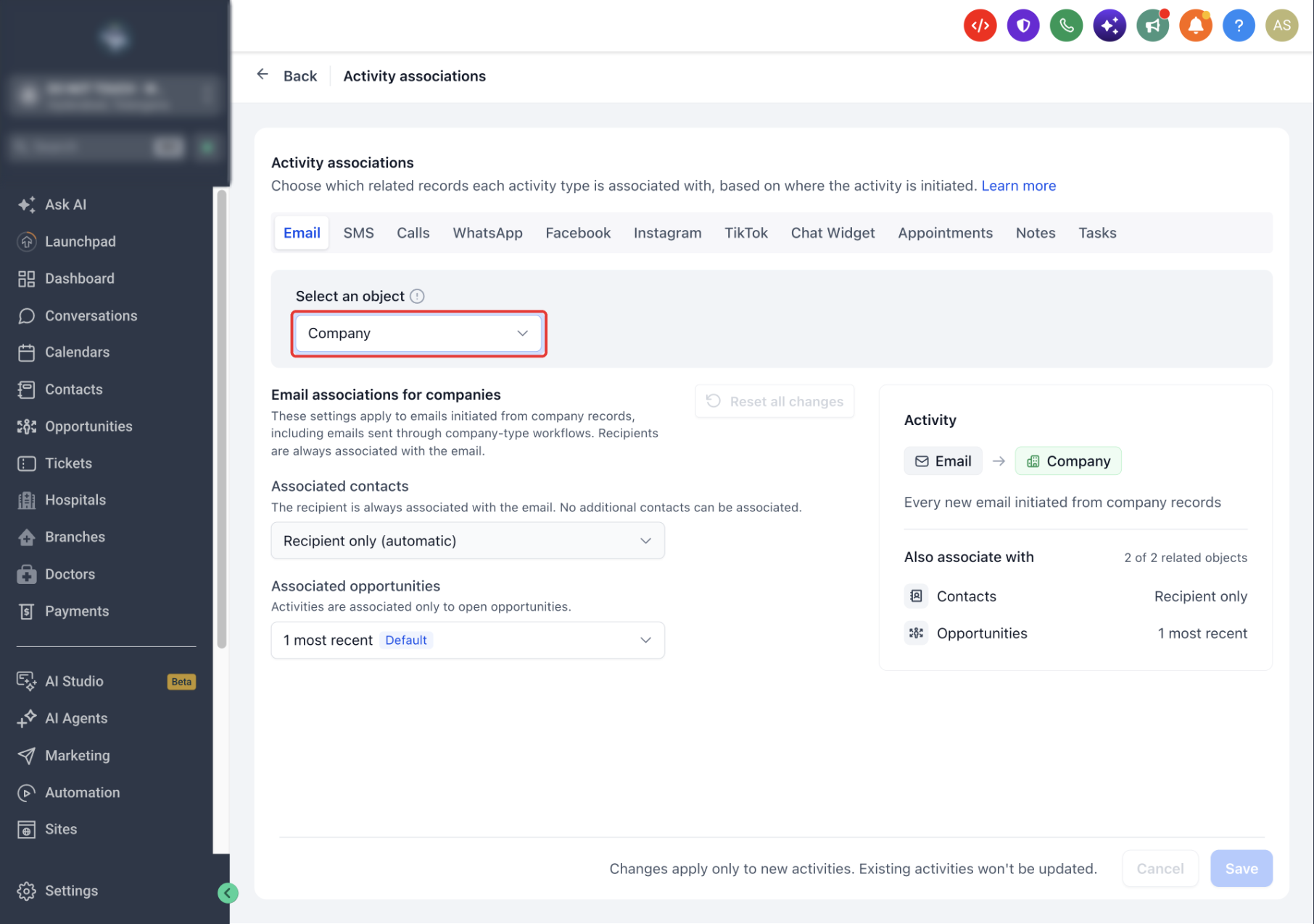
An email started from a Company follows Company rules, not Contact rules, even when the message is sent to a Contact.
Key Benefits of Default Activity Associations
Automatic associations help keep relevant communications and work history connected to the CRM records you use. Configuring these rules reduces the need to associate supported activities with related records manually.
- Connected activity history: View relevant messages, appointments, notes, and tasks on associated records.
- Less manual linking: Automatically select eligible related records when supported activities are created.
- Consistent associations: Apply saved rules to supported manual, incoming, and automated activities.
- Flexible configuration: Configure different rules for each activity type and originating object.
- Association preview: Review expected associations in the Activity panel before saving.
Prerequisites and Limitations
Before configuring activity associations, confirm that the feature is available and that you have administrator permissions. The available rules also depend on existing CRM relationships and the activity type you select.
- Private beta: Default activity associations must be enabled before the configuration option appears.
- Administrator access: Only administrators can open and change Default activity associations.
- Other users: Users without administrator permissions do not see the configuration button. They can still adjust suggested records on supported individual activities.
- Existing relationships: Related records must already be associated with the originating record for the rules to select them.
- New activities only: Changing rules does not update associations on previously created activities.
- Eligible Opportunities: Automatic Opportunity associations include only open Opportunities.
- Required participants: Message recipients and appointment attendees remain associated with their activities.
If an object has no configured associations, the page displays {Object} has no associations yet. Select Manage associations, create the required association, and return to the activity settings.
How to Set Up Default Activity Associations
Configure activity associations from the Objects settings. Select an activity type and originating object, choose the available rules, preview the expected associations, and save the configuration.
Configure Association Rules
Each activity type and originating object has its own association settings. Use the Activity associations page to control which eligible records are selected when a new activity is created.
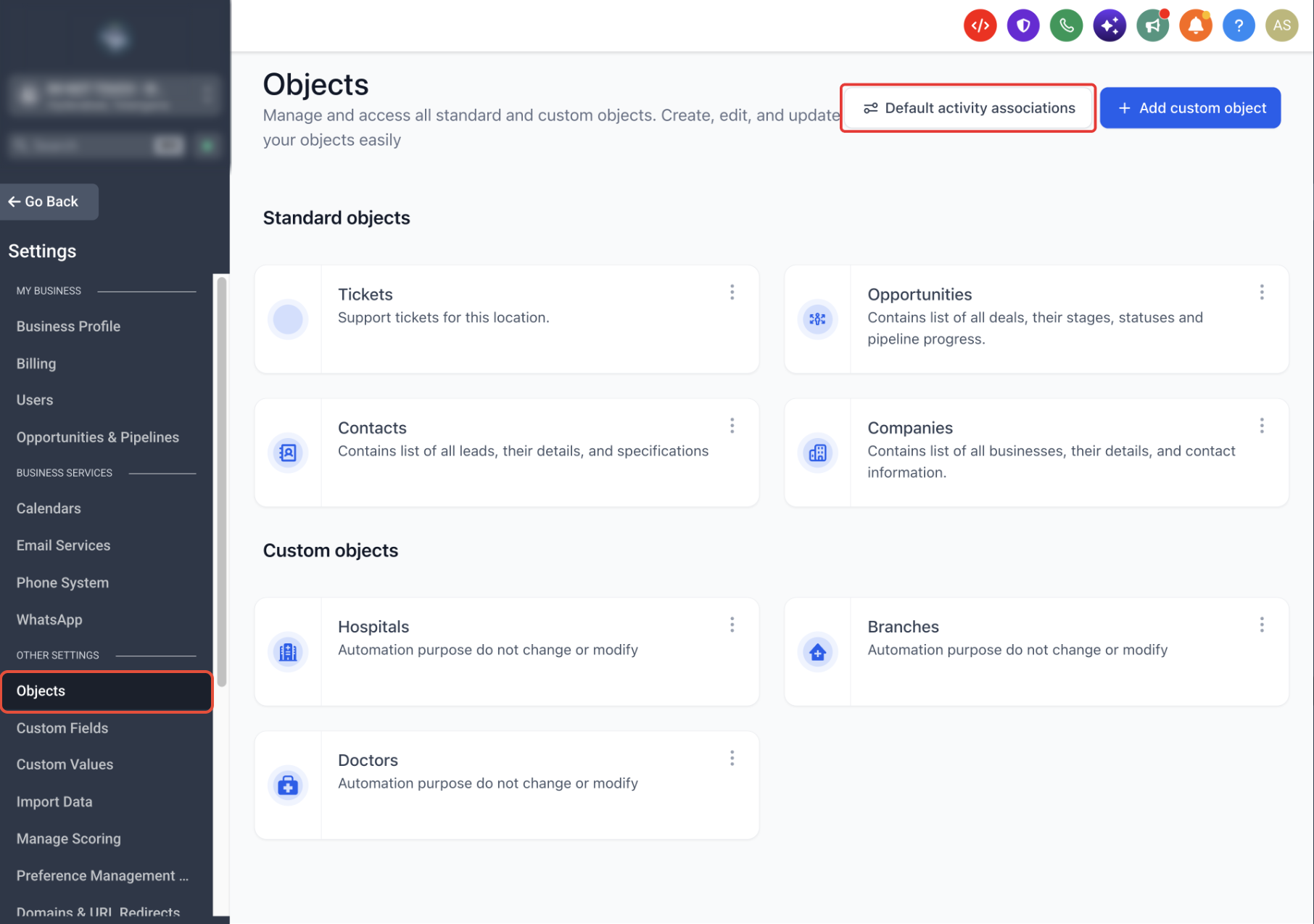
- From the left navigation menu, select Settings.
- Select Objects.
- Click Default activity associations in the upper-right area.
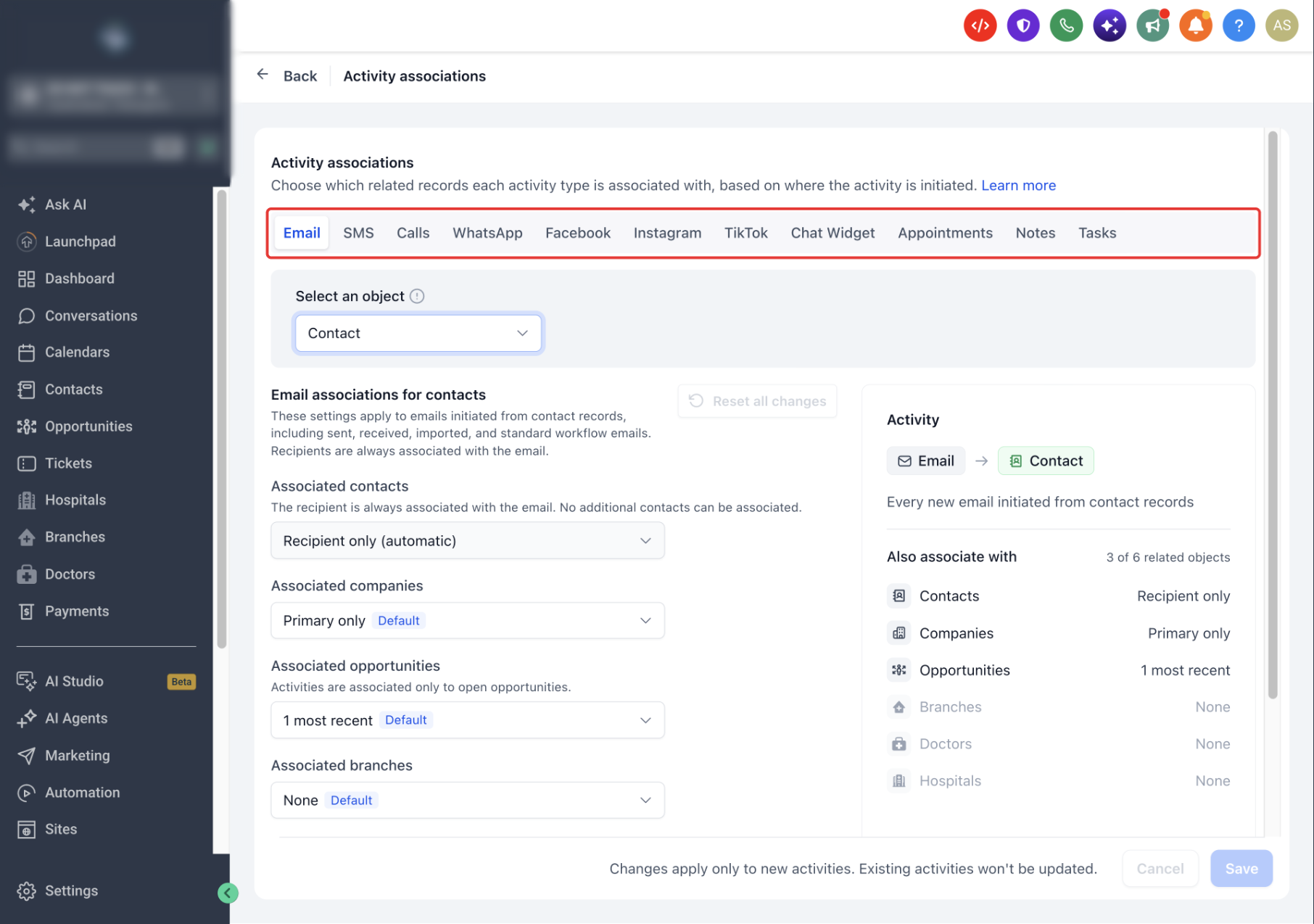
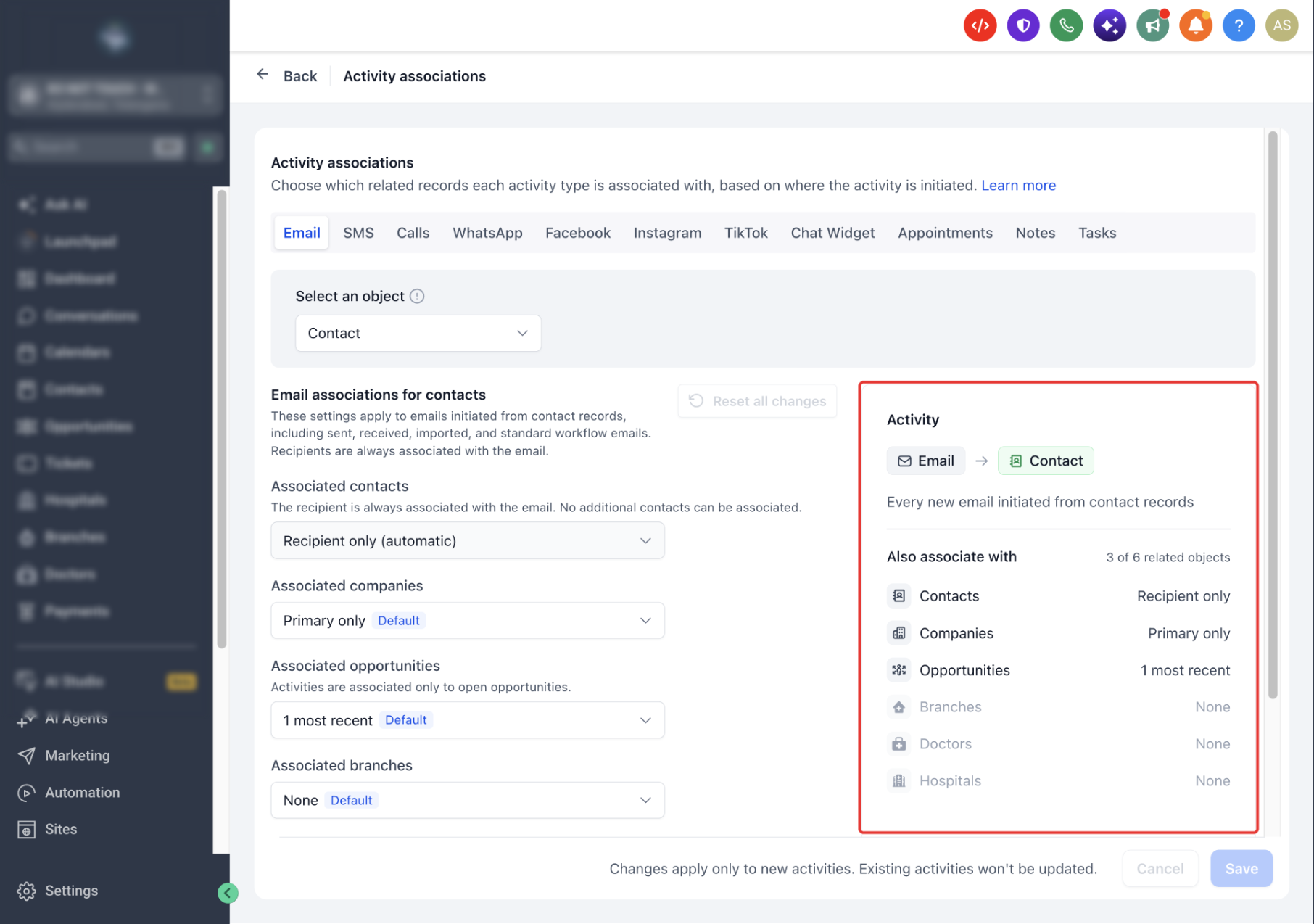
- On the Activity associations page, select the activity type you want to configure.
The available activity tabs include Email, SMS, Calls, WhatsApp, Facebook, Instagram, TikTok, Chat Widget, Appointments, Notes, and Tasks.
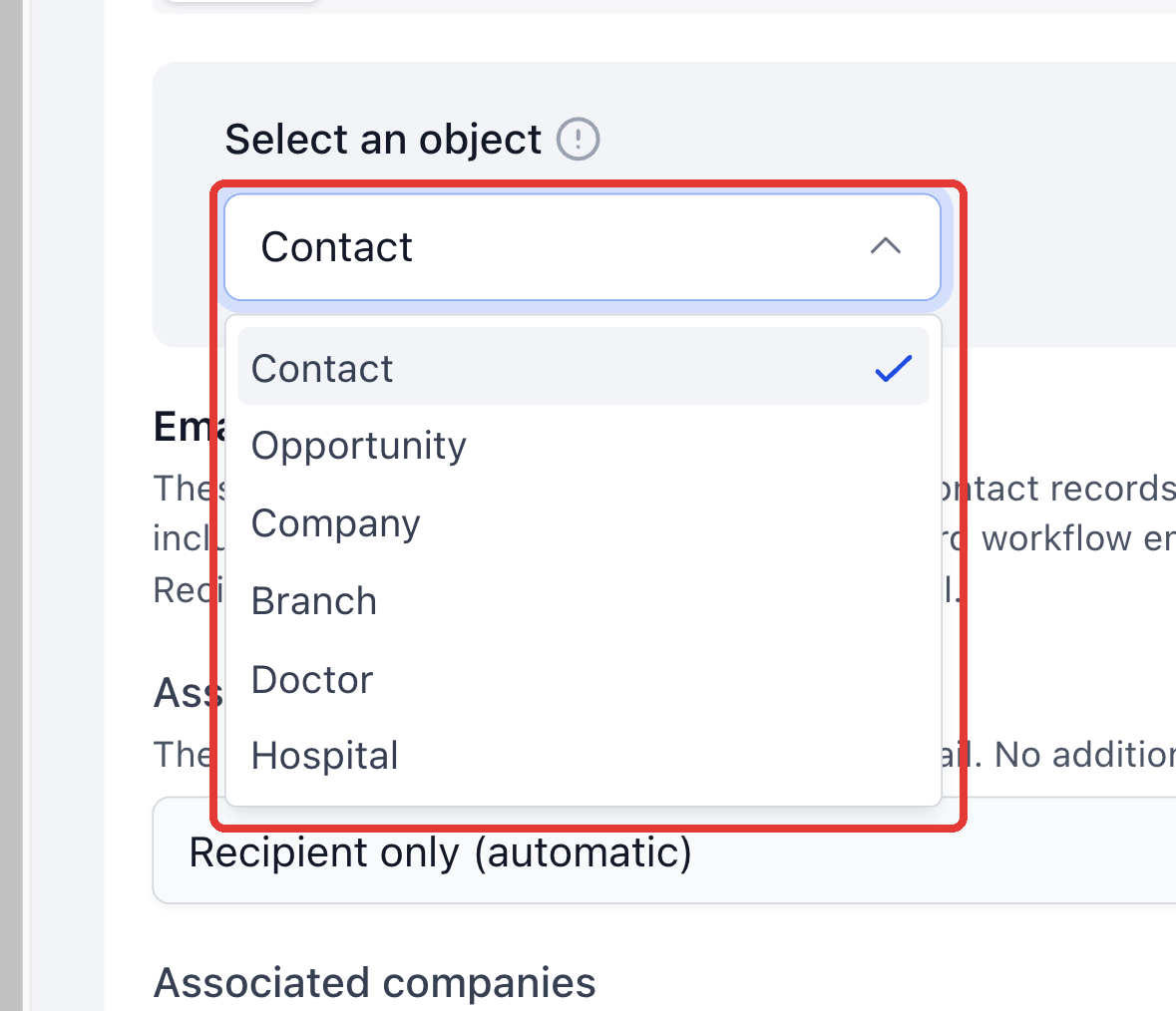
- Under Select an object, choose where the activity starts: Contact, Opportunity, Company, or an available Custom Object.
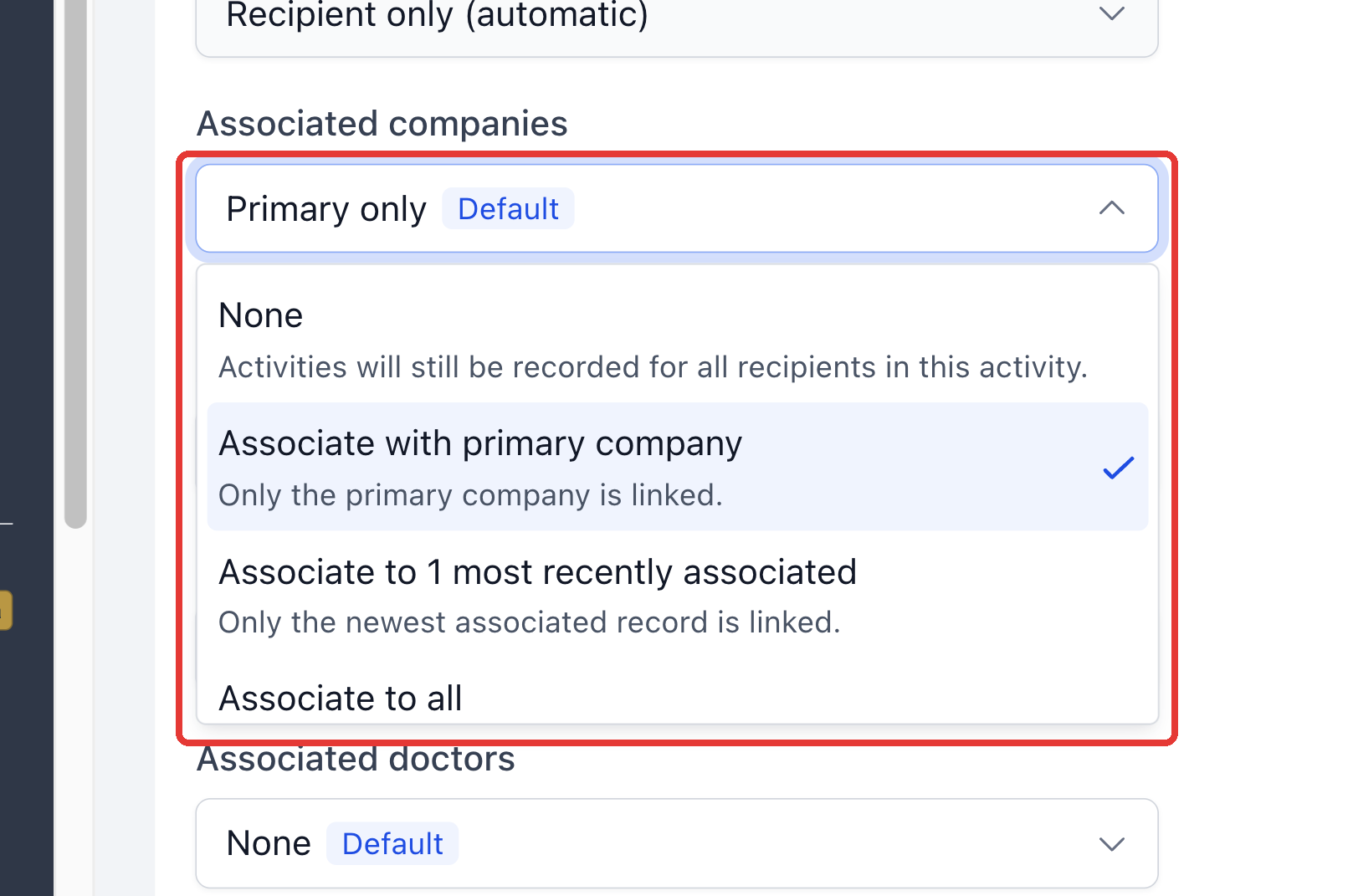
- Choose a rule for each editable related-object row, such as Associated companies or Associated opportunities.
- Review the Activity panel on the right to preview how the selected rules will associate records with new activities.
- Click Save to apply the selected association rules.
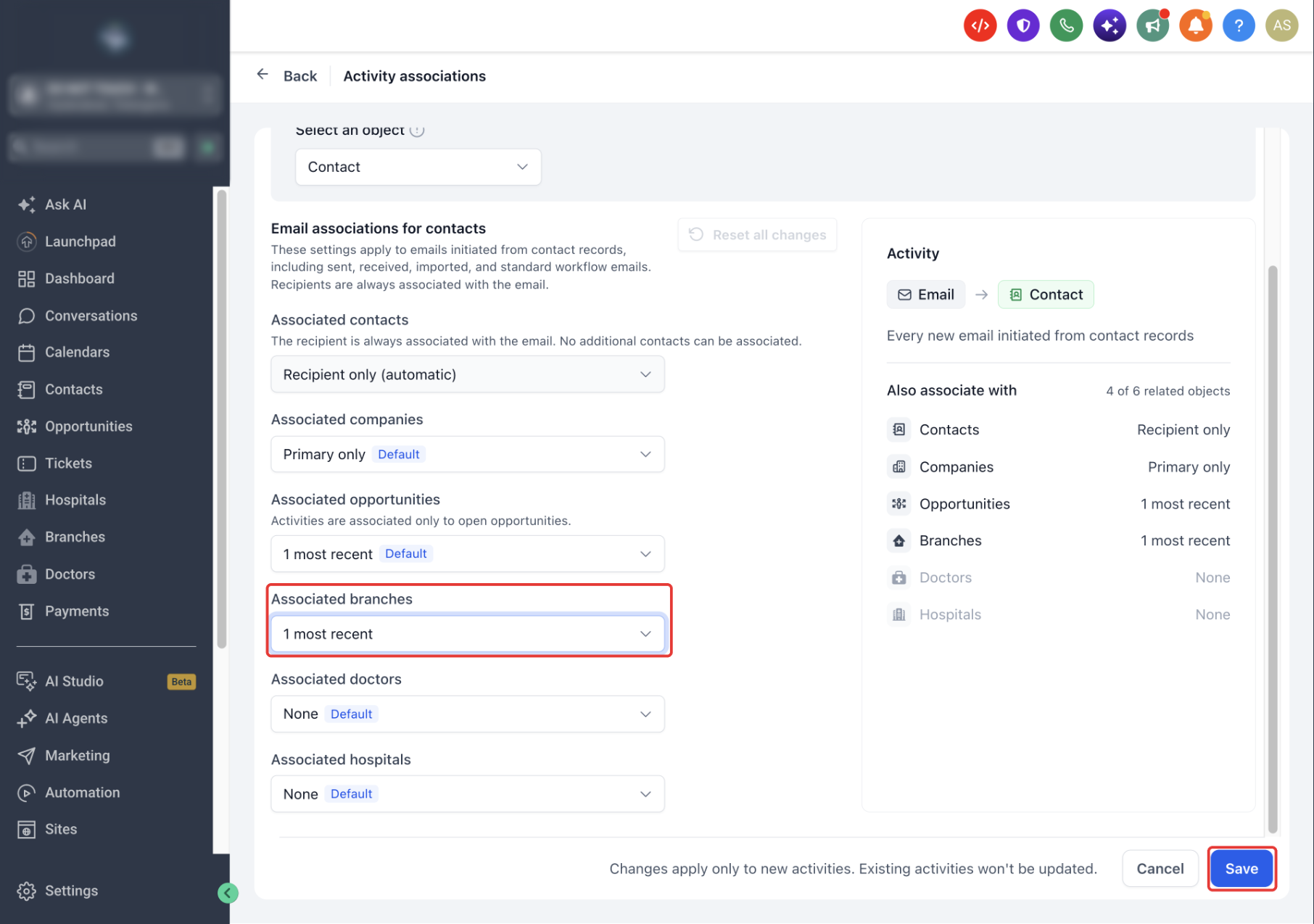
Rows marked Default retain their original settings. Changing a row removes that tag and enables Save. If an object has been renamed, its current name appears in the configuration.
Note: Association rules are saved separately for each activity type and originating object. Changing Email rules for Contact does not change Email rules for Company or SMS rules for Contact.
Reset Association Rules to Default
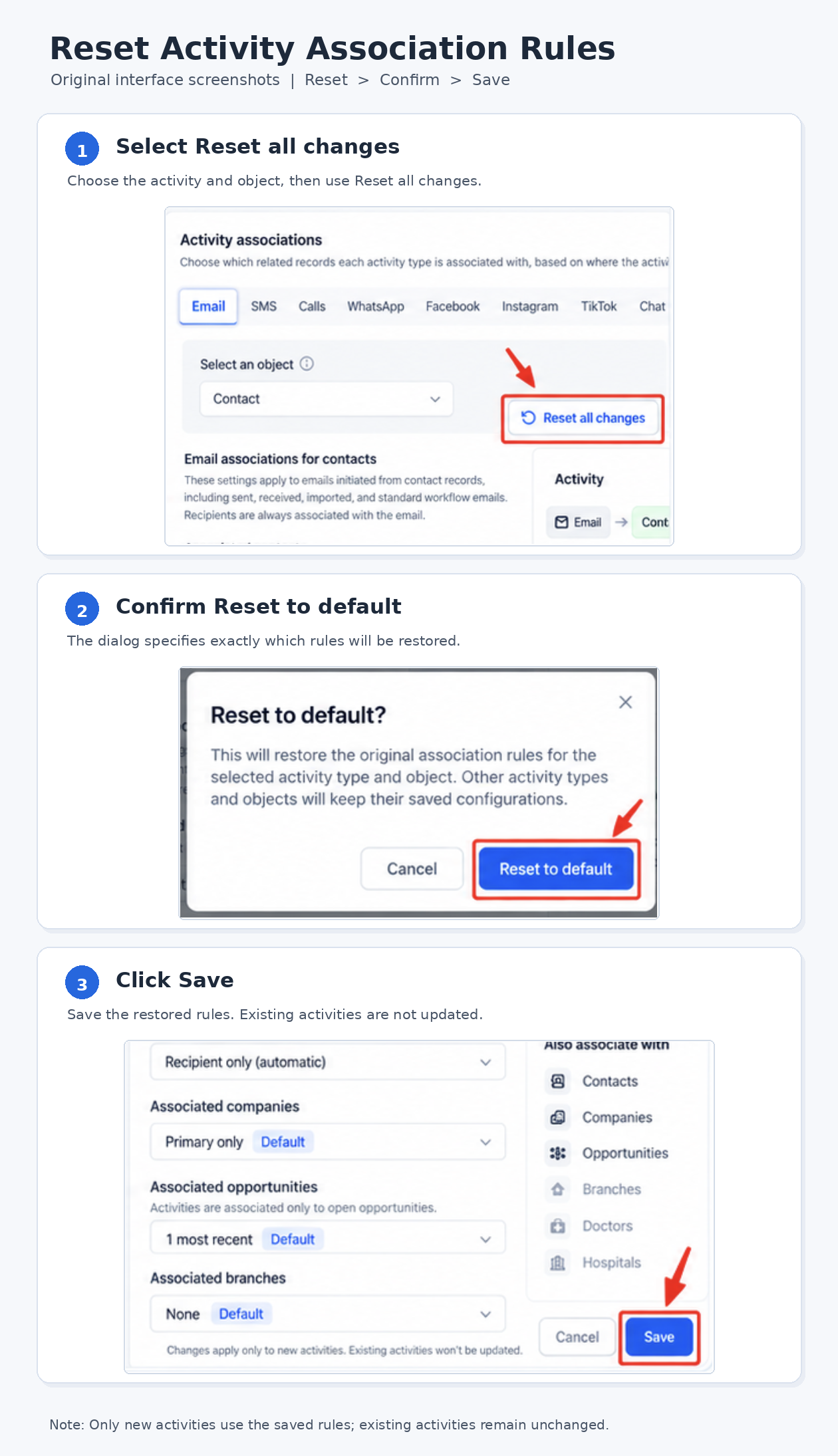
Use Reset all changes to restore the original rules for the selected activity type and originating object. Resetting one configuration does not change the saved rules for other activities or objects.
- From the left navigation menu, select Settings.
- Select Objects.
- Click Default activity associations.
- Select the activity type and originating object you want to reset.
- Click Reset all changes.
- In the Reset to default? confirmation, select Reset to default.
- Click Save to apply the reset.
Reset all changes is disabled until you have saved a change for the selected activity type and object. Confirming the reset does not apply it until you save.
Chat Widget Settings: Web chat and live chat share the Chat Widget configuration. Resetting Chat Widget restores the rules for both.
Association Rules and Default Behavior
Each related-object row determines how eligible records are selected. Available choices depend on the activity type and the relationships configured for the originating object.
Available Association Rules
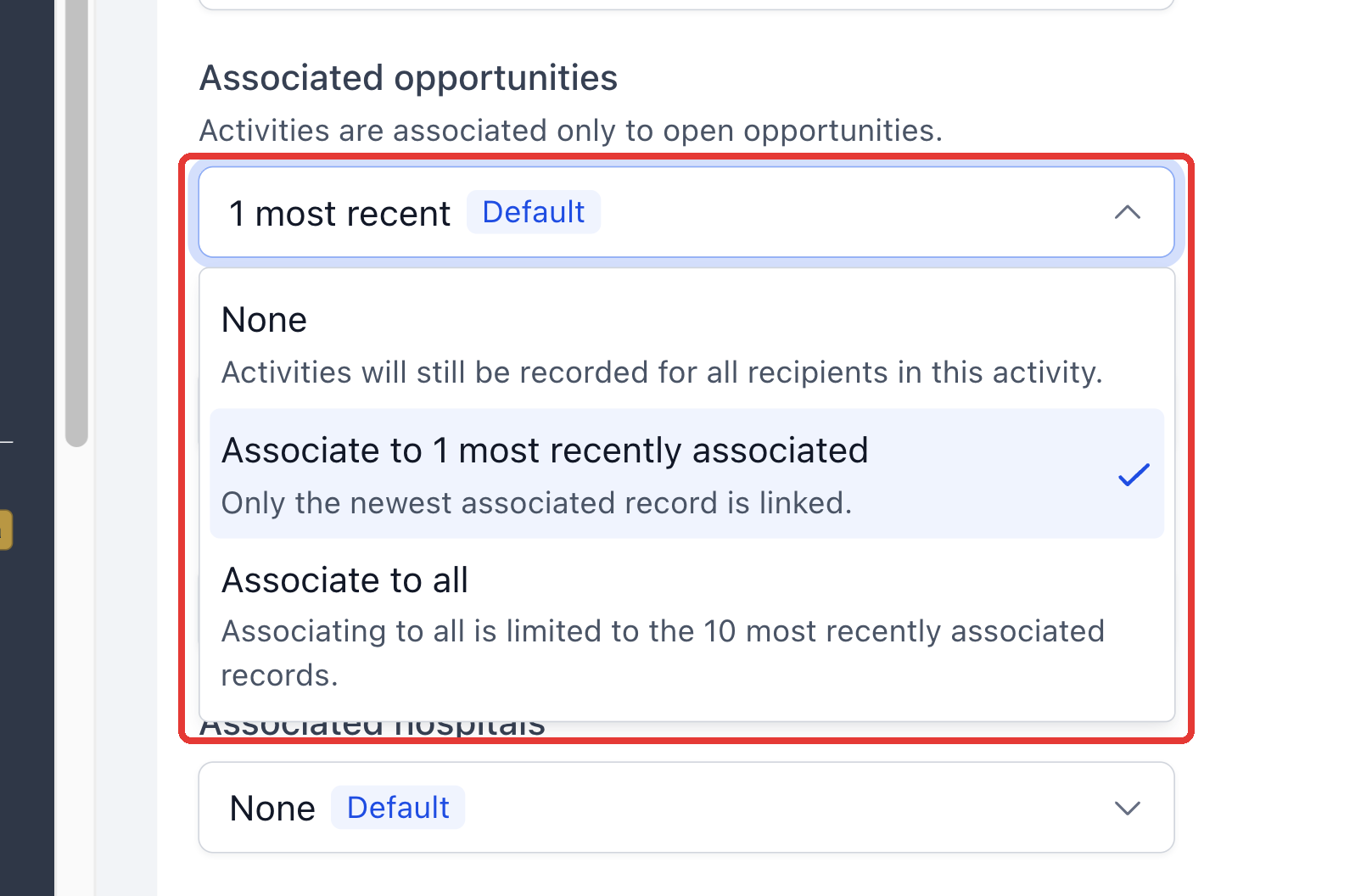
Association rules determine whether a new activity links to no additional records, a primary record, the most recently associated record, or multiple eligible records.
| Rule | Behavior |
|---|---|
| None | Does not add records of that related type. Required recipients and attendees remain associated. |
| Associate with primary {object} | Selects the related record with the Primary association label. This option appears only for supported Primary relationships. |
| Associate to 1 most recently associated | Selects the most recently associated eligible record of that type. |
| Associate to all | Selects up to the 10 most recently associated eligible records of that type. |
The interface can show shortened labels such as Primary only and 1 most recent. Primary options are available for supported relationships, including a Contact's Company and an Opportunity's primary Contact or Company.
If a Contact has associated Companies but none has the Primary label, the documented fallback selects the most recently associated Company.
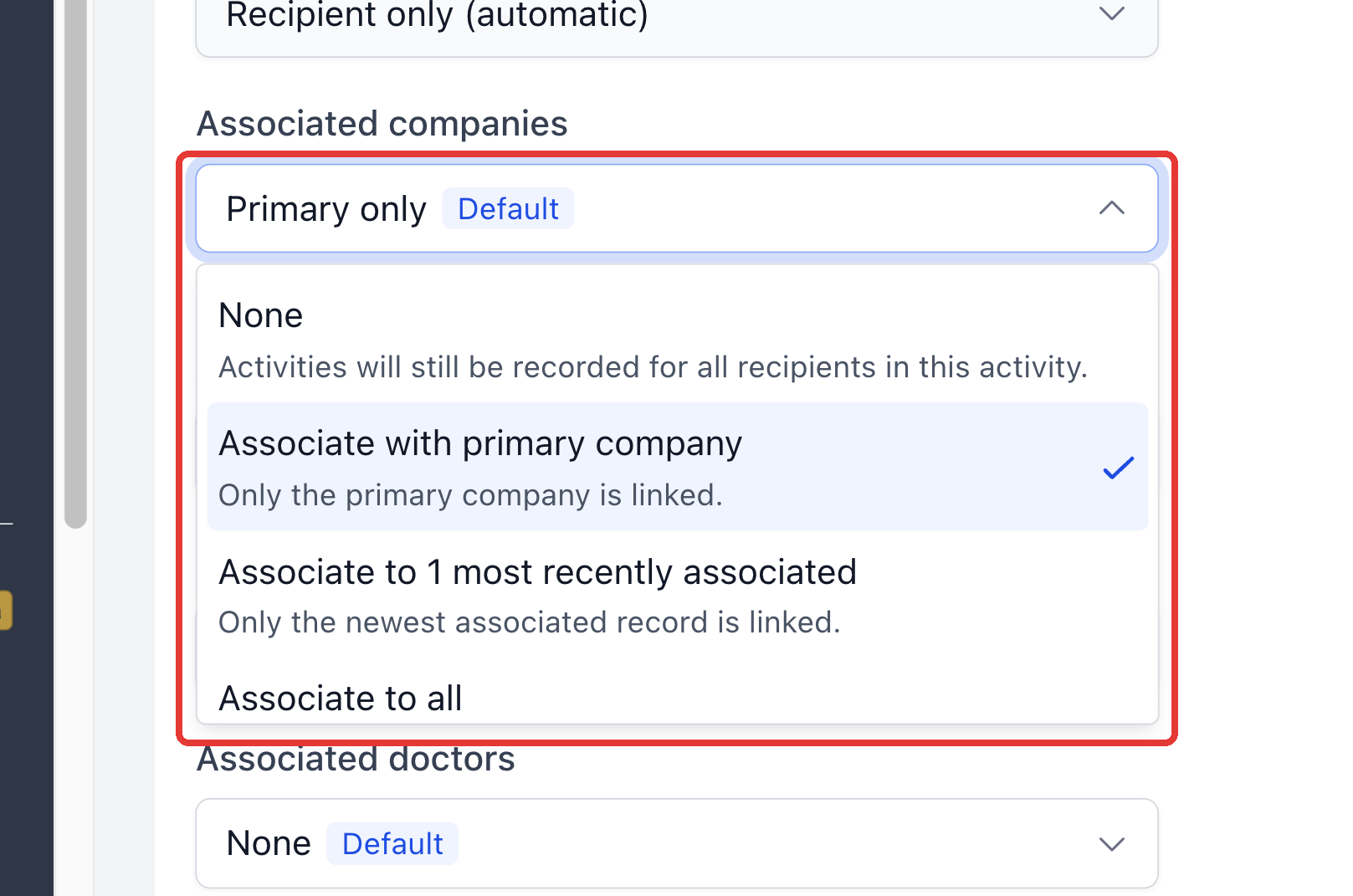
Some rows do not support Primary. For example, Associated opportunities offers the applicable recent-association choices and excludes closed Opportunities.
Activity-Specific Restrictions
Some associations are automatic or have stricter limits. The available options change to reflect the requirements of each activity type.
- Messages and supported calls: Associated contacts is locked to Recipient only (automatic).
- Appointments: Associated contacts is locked to Attendee only (automatic).
- Notes: Associate to all is unavailable because a Note can be associated with only one record per related object type.
- Opportunities: Automatic rules include only open Opportunities. Won, lost, and abandoned Opportunities are excluded.
Default Association Settings
The system provides starting rules for common CRM relationships. Administrators can change these rules for supported activity types and originating objects.
| Activity Starts On | Default Associations |
|---|---|
| Contact | Primary Company and one most recently associated open Opportunity. Recipients and attendees remain associated where applicable. |
| Opportunity | Primary Company. Notes and Tasks use the primary Contact; messages and appointments use the recipient or attendee. |
| Company | One most recently associated open Opportunity. Messages and appointments retain recipients or attendees. Notes and Tasks do not automatically add Contacts by default. |
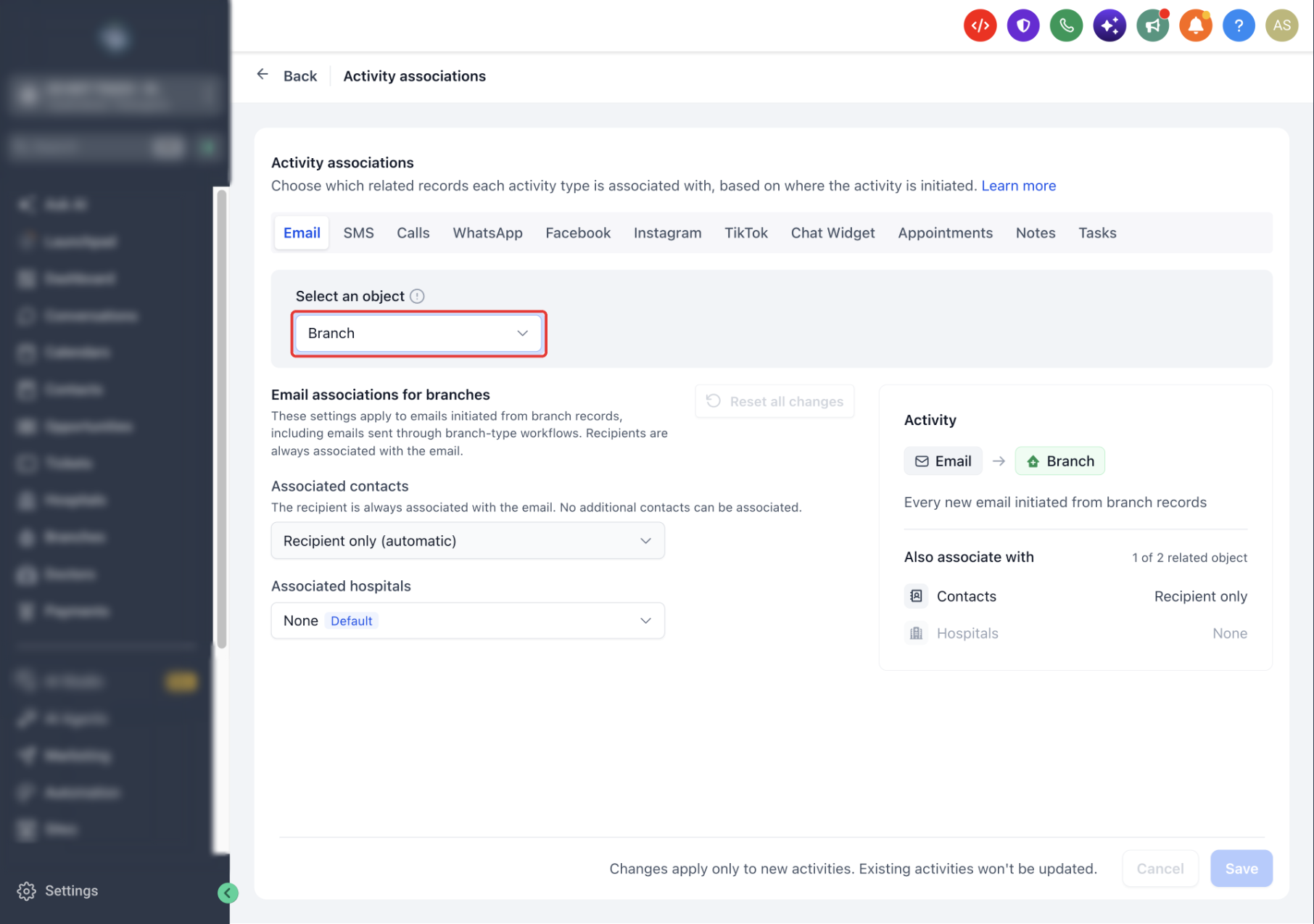
| Custom Object | No additional related objects by default. Messages and appointments still retain recipients or attendees. |
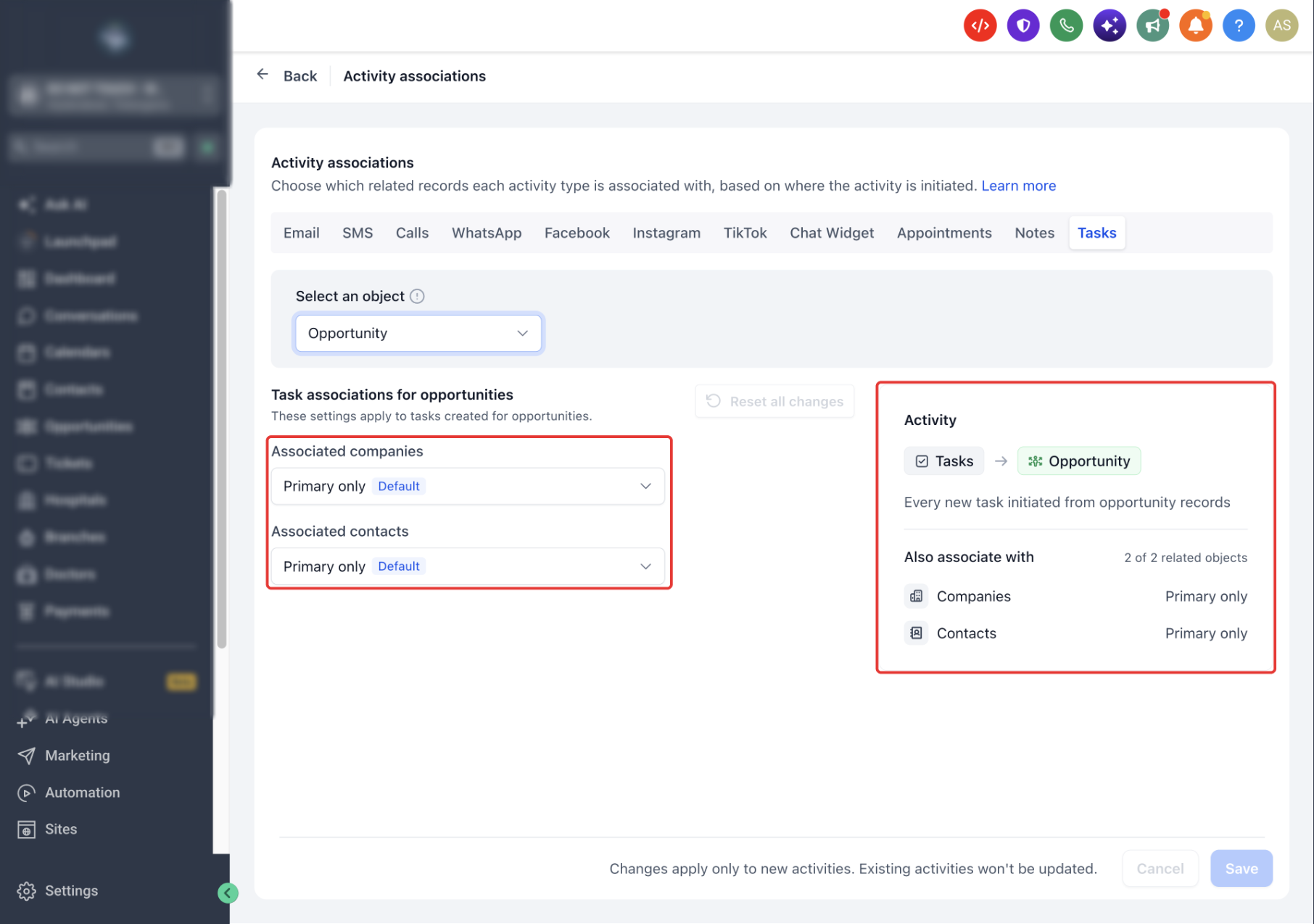
Once you change a row, the saved rule replaces that default for the selected activity type and originating object.
How the Rules Apply to Activities
The originating object determines which rules apply. The saved settings then select eligible related records when a new activity is created.
Which Rules an Activity Uses
Activities created manually generally use the object of the record where they start. Incoming messages, workflows, bulk actions, and self-booked appointments follow their applicable activity-source rules.
| How the Activity Is Created | Rules Used |
|---|---|
| Message, Note, Task, or Appointment started from a CRM record | The rules for the originating record's object. |
| Incoming email, SMS, call, or supported social or chat message | Contact rules. |
| Customer self-booking through supported channels, including booking widgets, supported Google booking options, Calendly, WhatsApp flows, and the client portal | Contact rules. |
| Supported AI-generated replies or appointment bookings | Contact rules. |
| Contact workflow, including a Contact workflow started by an Opportunity trigger | Contact rules. |
| Company workflow | Company rules. |
| Custom Object workflow | Rules for that Custom Object. |
| Workflow-created Note, Task, or Appointment | Rules for the record receiving the activity. |
| Bulk email or SMS | Rules for the object used to initiate the send, such as Contact, Company, or Custom Object. |
Emails imported into the supported Contact activity flow and messages sent through supported email or SMS providers follow their applicable Email or SMS rules.
Manual and Background Activities
When you create a supported activity manually, its composer or form shows the records selected by the configured rules. You can adjust those associations for the individual activity without changing the saved defaults.
- Manual activities: Review, add, or remove the selected records before saving or sending.
- Background activities: Incoming messages, workflow activities, and self-booked appointments receive additional associations after creation.
- Processing time: Additional associations may take a few seconds to appear on background activities.
- Individual overrides: Changing one activity's associations does not change the configured rules.
How Related Records Are Selected
Rules use the relationships that exist when the activity is created. If you associate another record afterward, the older activity is not automatically updated.
- Primary: Selects the record marked Primary at creation time. Changing the Primary label affects future activities.
- Most recent: Selects the most recently associated eligible record, not necessarily the most recently created CRM record.
- Associate to all: Selects up to 10 of the most recently associated eligible records.
- Existing Opportunity: An activity already associated with an Opportunity does not receive another Opportunity through these rules.
- Existing Note association: A Note already associated with one record of an object type does not receive a second record of that type.
- Existing associations: Default rules add eligible records; they do not remove records already on the activity.
Example: A Contact has three open Opportunities. With Associate to 1 most recently associated, the rule selects the eligible Opportunity most recently associated with that Contact, not necessarily the Opportunity created most recently.
Activity Limits and Exceptions
Different activity types have different association limits. Some creation methods also bypass automatic association rules, so review these restrictions before relying on automatic linking.
Association Limits
The number of records that can be associated depends on the activity type and the rule being used.
| Activity or Rule | Limit |
|---|---|
| Notes | One associated record per related object type. |
| Tasks | Up to 10 associated records per object type, including records already on the Task. |
| Manually created Appointments | Up to 10 associated records in total, excluding the Contact. |
| Associate to all | Up to the 10 most recently associated eligible records of the selected type. |
Activities Not Covered by Automatic Rules
The following activities or creation methods do not receive additional records through the default association rules.
- Existing activities: Changing or resetting rules does not retroactively update older activities.
- Imported or bulk-created Notes and Tasks: These keep the associations selected by the import or bulk action.
- Public API-created Notes, Tasks, and Appointments: These do not receive additional associations through these rules.
- Unsupported third-party appointment integrations: Appointments created through these integrations are excluded from automatic linking.
Incoming messages received through the API still use Contact rules. Bulk email and SMS sends also use their applicable association rules.
Frequently Asked Questions
Q: Why wasn't a Company associated with a new activity?
Confirm that the Company was already associated with the originating record when the activity was created. Review the configured rule and check the Primary label when applicable.
Q: Why didn't an email from a Company workflow appear on the Contact's Opportunity?
Company workflows use Company rules, not Contact rules. Open Settings → Objects → Default activity associations, select Email and Company, and review the Associated opportunities setting.
Q: Which rules apply when an Opportunity trigger starts a Contact workflow?
Contact rules apply. The workflow is Contact-based, even when its trigger references an Opportunity.
Q: Why can't I choose Associate to all for Notes?
Notes support only one associated record per related object type. The Associate to all option is unavailable for Notes.
Q: Can I change the associated records on one activity?
Yes. Adjust the selected records before saving or sending a supported manual activity. These changes affect that activity without changing the default settings.
Q: Will Reset all changes update older activities?
No. Reset restores the original configuration for the selected activity type and object after you save. It does not change existing activity associations.
Q: Why can't I see the Default activity associations button?
Only administrators can access these settings. The feature must also be available through the private beta. Contact support if you need help confirming availability.
Need Help?
If an activity is not associated with the expected records, review the selected activity type, originating object, and saved association rules. Confirm that the related records were associated before the activity was created and that they meet any applicable limits or restrictions.
If you cannot access Default activity associations or need additional assistance, contact support. Include the activity type, originating object, selected rule, and a description of the issue to help with troubleshooting.